Have you ever spent any time around a toddler?
If so, you've probably noticed that they aren't particularly good at sitting still. They wiggle, climb, run, jump, spin, crawl, bounce, explore, and generally behave like tiny humans who have misplaced their off switches.
And thank goodness for that.
Movement is an essential part of childhood development. It helps children develop coordination, balance, body awareness, motor skills, problem-solving abilities, and the ability to interact with and understand the world around them. Movement also provides opportunities to explore, experiment, build confidence, and regulate their emoti
ons.
We don't expect a two-year-old to sit quietly in a chair for hours while they learn about the world. We understand that they need opportunities to move their bodies, explore their environment, and learn through doing.
And it's not just children. Adult humans need movement, too.
Think about what you do when you're frustrated, stressed, overwhelmed, or just having a particularly crappy day. Maybe you go for a walk, head to the gym, take a bike ride, dance around the kitchen, or simply get up and move your body for a few minutes.
We intuitively understand that movement can help us process emotions, manage stress, and change how we're feeling.
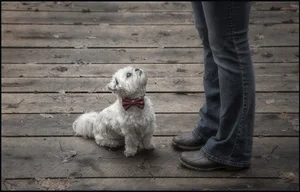
So why do we sometimes expect something entirely different from our dogs?
Dogs Need to Move, Too!
Puppies and adolescent dogs are developing physically, cognitively, and emotionally. They’re learning how their bodies work, how to navigate their environment, how to communicate, and how to respond to all the interesting (and sometimes incredibly annoying) things happening around them.
Movement is a huge part of that development.
Yet so much traditional dog training focuses on stillness. Sit. Down. Stay. Wait. Don’t move.
And while these behaviors certainly have their place, I think we’ve become a little too comfortable using them as our go-to solutions for just about everything.
Dog is excited? Ask for a sit.
Dog is distracted? Ask for a sit.
Dog is having a hard time? Definitely ask for a sit.
But here’s the thing: Stillness isn’t always the answer to movement, excitement, frustration, or emotional overwhelm. Sometimes movement is exactly what a dog needs.
Just as we wouldn’t expect a young child to work through every emotion by sitting quietly with their hands in their lap, or recommend an adult manage every stressful situation by sitting perfectly still, we shouldn’t expect dogs to do it either.
Movement gives dogs opportunities to explore, learn, develop physical skills, and engage with their environment. It can also provide an outlet for energy and help them shift their emotional state.
And from a training perspective, movement can be an incredibly useful tool.
Think About the Child. Think About Yourself.
Let’s go back to that toddler.
Imagine a young child who’s having a difficult day. They’re tired, overstimulated, frustrated, and surrounded by things they don’t quite know how to process.
Would your first strategy be to insist they sit perfectly still until they feel better?
Probably not.
You might take them outside, let them run around, give them something to play with, take a walk, or offer an activity that helps them redirect their attention.
Now think about yourself.
You’ve had a stressful day. You’re frustrated, overwhelmed, or maybe just mentally exhausted. Would you prefer someone to tell you to sit down, stay perfectly still, and stop having feelings?
Or would you rather take a walk, get some fresh air, move your body, and have an opportunity to work through some of what you’re feeling?
Most of us recognize that movement can make a difference.
Dogs aren’t any different in their need for opportunities to move, explore, and engage with their environment.
Their developmental needs aren’t identical to ours, of course, but the underlying principle is the same: movement is an important part of learning, development, and emotional wellbeing.
We shouldn’t be surprised when dogs benefit from having more opportunities to move rather than being asked to spend more time sitting still.
Should We Stop Teaching Sit and Down? Maybe.
Okay, maybe that’s a little dramatic.
Sit, down, stay, and other stationary behaviors are useful skills. There are plenty of situations where they’re appropriate and valuable.
The problem isn’t teaching these behaviors. It’s relying on them as the answer to everything.
A sit isn’t a magic button that makes a dog calm. A down doesn’t automatically mean a dog is comfortable. And a dog who can hold a stay isn’t necessarily a dog who knows how to navigate an exciting or overwhelming situation.
I want dogs to have a whole toolbox of behaviors they can use in their daily lives. Some involve stillness. Many involve movement.
I want them to know how to follow a hand target, search for treats, navigate obstacles, explore their environment, move with their humans, and participate in activities that give them opportunities to use their bodies and brains.
I also want their humans to understand that sometimes the best thing they can do for their dog isn’t to ask them to stop moving.
It’s to help them move in a way that makes sense.
The Bottom Line, not get your bottom on the line
Movement isn’t just exercise. It’s an opportunity to learn, explore, develop skills, build confidence, communicate, and interact with the world.
So the next time you’re working with your dog, consider how many times you’re asking them to sit, stay, or lie down compared to how many opportunities you’re giving them to move.
Could that training session include a few hand targets? A treat toss game? Some fun tricks? A little sniffing adventure?
Could you replace one stationary behavior with a movement behavior?
You might be surprised at how much more successful your dog becomes when you stop asking them to spend so much time standing (or sitting) around doing nothing.
After all, we wouldn’t expect a toddler to learn about the world by sitting on their bottom all day. And we wouldn’t expect ourselves to manage every big feeling by sitting perfectly still.
Let’s give our dogs the same opportunity to move, explore, and learn.
Go ahead. Move it, move it! 🐾