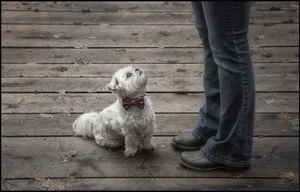
Ice, Ice Baby
One of the biggest surprises of my career had nothing to do with dog behavior.
It was flooring.
When I started teaching virtual classes during COVID, I suddenly got a front-row seat inside hundreds of people's homes. And I was shocked by how many dogs were expected to live almost exclusively on hardwood, laminate, vinyl, or tile floors—with little to no carpet or area rugs.
Watching dogs resist sits and downs was common in these classes.
It wasn't that they didn't know the behavior.
It was that they didn't trust the floor.
From that point on, I made a non-slip surface a requirement for all of my Zoom classes. If we're going to evaluate your dog's behavior or teach new skills, they deserve a surface where they can actually succeed.
Imagine Living on Ice
Imagine if every floor in your home was covered with a thin sheet of ice.
You could still walk.
You could probably still sit down.
You could even carry a cup of coffee from the kitchen to the living room.
But every movement would require extra thought.
Your muscles would stay tense.
You'd take shorter steps.
You'd constantly brace yourself against falling.
Now imagine doing that every single day for years.
That's what many dogs experience in their own homes.
"My Dog Is Stubborn."
As trainers, we hear it all the time.
"My dog won't sit."
"He refuses to lie down."
"He's just stubborn."
Sometimes, the dog isn't refusing the behavior.
They're refusing the surface.
Think about what a sit actually requires.
Your dog has to shift their entire body weight backward while folding their back legs underneath them. On a slippery floor, that's like asking someone to perform a squat on an ice rink.
A down is even harder. Dogs have to lower themselves in a controlled way while transferring weight forward. If their feet slide in opposite directions, that position can feel unstable—or even scary.
Many dogs quickly learn that sitting or lying down on slick floors is uncomfortable, embarrassing, or painful. So they stop offering those behaviors.
Not because they're stubborn.
Because they're making a smart decision based on past experience.
Even Mealtime Can Be Stressful
Now picture trying to eat dinner while standing on ice.
Every time you lean forward to take a bite, your feet start sliding apart.
You'd spend more energy trying to stay upright than actually enjoying your meal.
Many dogs experience exactly this.
They brace their legs while eating.
They constantly shift their feet to regain balance.
Some rush through meals. Others avoid the bowl altogether until they feel more secure.
Something as simple as eating shouldn't require full-body stabilization.
The Physical Cost Adds Up
Dogs are masters at compensating.
Just because they can walk across slippery floors doesn't mean they're doing it comfortably.
Over months and years, constantly adjusting their posture and tensing their muscles can contribute to:
Muscle soreness and chronic tension
Repeated strains and sprains
Hip, knee, shoulder, and back discomfort
Increased stress on joints
More frequent slips and falls
Worsening mobility for dogs with arthritis or orthopedic conditions
I've also seen dogs lose confidence after a bad fall. One painful slip can make them think twice before running to greet you, chasing a toy, or even walking into certain rooms.
Behavior Starts with Comfort
We often focus on motivation.
More treats.
Better timing.
Higher-value rewards.
But sometimes the environment is the real problem.
If your dog doesn't feel physically safe, learning becomes harder.
They're less likely to move freely.
Less likely to experiment.
Less likely to offer behaviors.
Less likely to enjoy training.
When we label those dogs as "stubborn," we're missing the bigger picture.
Small Changes Make a Huge Difference
The good news is that your house doesn't need wall-to-wall carpeting.
Strategically placed area rugs and runners can completely change how your dog moves through your home.
Think about the places your dog uses every day:
From their bed to the water bowl.
The path to the back door.
Around their food bowl.
The living room where you train.
Anywhere they jump on or off furniture.
Giving them secure footing in these areas can improve not only their confidence but also their willingness to participate in training and everyday life.
Look at the Floor Before the Dog
The next time your dog "refuses" to sit or lie down, take a second to look beneath their feet before assuming it's a training problem.
Ask yourself:
Would I want to do a squat on ice?
If the answer is no, your dog probably doesn't either.
Sometimes the kindest, most effective thing we can do isn't a better training technique.
It's simply giving our dogs a surface where they feel safe enough to move.
Sara Sokol is owner of Mr. Dog Training in Brunswick and West Gardiner Maine; A positive reinforcement dog trainer with two facilities, offering both virtual and in person classes, and a Canine Enrichment Center, and has been voted best training in Maine.