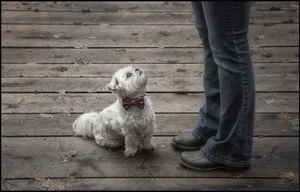
Who ‘dis?
The Dog You Adopted Isn’t Necessarily the Dog You’ll Have in Six Months
One of the more challenging things about bringing home a rescue dog is realizing that the dog you adopted may not actually be the dog who eventually lives in your house.
And no, I don't mean that your dog is going to secretly turn from a chihuahua a Great Dane six months from now.
I mean their behavior may change dramatically once they feel safe.
When a dog first arrives in a new home, they're dealing with an enormous amount of information. New people. New smells. New sounds. New routines. New expectations. New surroundings.
Some dogs respond to all of this by becoming very quiet.
They may sleep constantly. Follow you everywhere. Avoid eye contact. Show little interest in toys. Walk politely on a leash. Seem remarkably easygoing.
You might think:
Wow. We really lucked out.
And then, a few weeks later, your dog starts barking at the mail carrier.
They discover they have opinions about other dogs.
They suddenly don't want you touching their feet.
They start stealing socks.
They bark when you leave the room.
They decide that the vacuum cleaner is their mortal enemy.
And you may find yourself wondering:
“What happened to my perfect dog?”
Probably nothing.
In many cases, you're simply meeting more of the dog.
The quiet dog isn't necessarily a calm dog.
Dogs don't always immediately feel comfortable enough to express themselves.
A newly adopted dog may be in a state of inhibition. They're observing. Gathering information. Figuring out what is safe and what isn't.
Think about walking into a party where you don't know anyone.
You're probably not going to immediately start rearranging the furniture, telling inappropriate jokes and stealing someone's cheese.
You're going to look around.
You're going to figure out who is there.
You're going to assess the vibe.
And once you realize you're comfortable?
Well... that's when people discover your weirdness.
Dogs can be the same way.
A dog who spends the first few weeks quietly following you around may eventually become playful, vocal, opinionated, goofy, affectionate, independent, fearful, pushy, or reactive.
Sometimes they'll become more behaviorally challenging.
But that's not necessarily a sign that the adoption is going badly.
It can actually mean your dog is becoming comfortable enough to communicate. This is a good thing.
The honeymoon period can be misleading.
There's a reason people sometimes describe the early period after adoption as a honeymoon.
Everything is new.
The dog may be exhausted.
Their environment is relatively predictable because you're carefully managing it.
They haven't yet figured out all the things that exist in their new world.
They may not have learned which behaviors work to get what they need.
And you haven't yet learned all of their preferences, triggers, boundaries, and quirks either.
Then life starts happening.
The garbage truck comes by.
Someone knocks on the door.
You have guests.
You leave for work.
The dog sees a squirrel.
Someone reaches toward their food bowl.
A stranger tries to pet them.
You attempt to clip their nails.
And suddenly you're thinking:
“Where did THIS dog come from?”
They came from the same place as the dog you brought home.
You just hadn't met this part yet.
This is why it’s so important to start a relationship based skills class like my Brilliant Basics class, ASAP when bringing a new dog home. The communication and trust, not obedience, that is built in a class like that will start you off on the right paw and help prevent your new best friend from not knowing how to handle themselves in these new situations.
This is why I don't recommend rushing a new rescue dog into their new life.
It's tempting to want to show your new dog everything.
Here's the neighborhood!
Here's the dog park!
Here's the pet store!
Here are all your new friends!
Here's my entire extended family!
Let's go hiking!
Let's go to brunch!
Let's have a puppy playdate!
And while enrichment and positive experiences are wonderful, more isn't automatically better.
Your new dog doesn't need to experience their entire new life in the first two weeks.
They need time to figure out what this life actually is.
Where do they sleep?
Who feeds them?
What happens when they bark?
Can they walk away when they don't want interaction?
Is the food bowl safe?
Does the human respect their space?
What happens when they're scared?
What happens when they make a mistake?
Are they allowed to say no?
Those answers matter far more than how many adventures you manage to squeeze into their first month.
So what should you do when new behaviors appear?
First, don't panic.
Second, don't immediately assume you've done something wrong.
And third, resist the urge to punish the behavior simply because you didn't see it during the first few weeks.
Instead, get curious.
What changed?
What happened immediately before the behavior?
What does your dog seem to be communicating?
Is the behavior happening because they're afraid?
Frustrated?
Overwhelmed?
Trying to create distance?
Trying to access something they want?
Trying to avoid something they don't want?
Or perhaps they're simply discovering that barking at the window makes the squirrel go away.
Once your dog realizes a behavior works, they're likely to use it again.
That's not manipulation.
That's learning.
And now you have useful information.
Your dog may also become MORE themselves.
Not every change is a problem.
A dog who initially seemed withdrawn may eventually start bringing you toys.
A dog who barely moved from their bed may suddenly play around the living room.
A dog who didn't seem interested in affection may start leaning against you.
A dog who seemed serious and reserved may turn out to be an absolute clown.
You may discover that your “quiet little dog” is actually extremely excited about dinner. (I can relate)
Or that the dog who never played at the shelter has a particular obsession with squeaky chickens.
The good changes count, too.
We sometimes talk about behavioral change after adoption as though it's automatically a problem.
It isn't.
Your dog is learning.
And you're learning them.
Give yourself time to meet the whole dog.
One of the biggest mistakes we can make with rescue dogs is deciding who they are too quickly.
“This is a shy dog.”
“This is an easy dog.”
“This is a reactive dog.”
“This dog doesn't like men.”
“This dog loves other dogs.”
“This dog has separation anxiety.”
Maybe.
Or maybe you're looking at one tiny snapshot of a dog who is still figuring out what their life looks like.
Instead of asking:
“What kind of dog did I adopt?”
Try asking:
“Who is this dog becoming now that they feel safe?”
Because your rescue dog isn't a finished product.
Neither are you.
You're building a relationship with a living, breathing creature whose behavior will change as their environment, experiences, confidence, health, and understanding change.
Six months from now, you may have a completely different dog.
You didn't just give a dog a home.
You gave them the opportunity to finally show you who they are.
Sara Sokol is owner of Mr. Dog Training in Brunswick and West Gardiner Maine; A positive reinforcement dog trainer with two facilities, offering both virtual and in person classes, and a Canine Enrichment Center, and has been voted best training in Maine.